Timezone Adjustments Challenging Form in International Golf and Rugby Competitions
Written by Sage Braun · Jun 2, 2026

Timezone Adjustments Challenging Form in International Golf and Rugby Competitions
Global sports circuits have long dealt with travel demands that extend beyond physical fatigue, and timezone shifts represent a measurable factor in performance consistency across golf majors and rugby test series, where athletes cross multiple time zones within short periods, according to data compiled by the Australian Institute of Sport.
Researchers have tracked how circadian rhythm disruptions alter sleep patterns, reaction times, and decision-making processes, while players in both sports encounter these effects during extended tours that span continents. Studies indicate that the human body requires approximately one day to adjust for each hour of time difference, a timeline that frequently conflicts with packed competition schedules in professional golf and rugby.
Circadian Challenges in Multi-Stage Travel
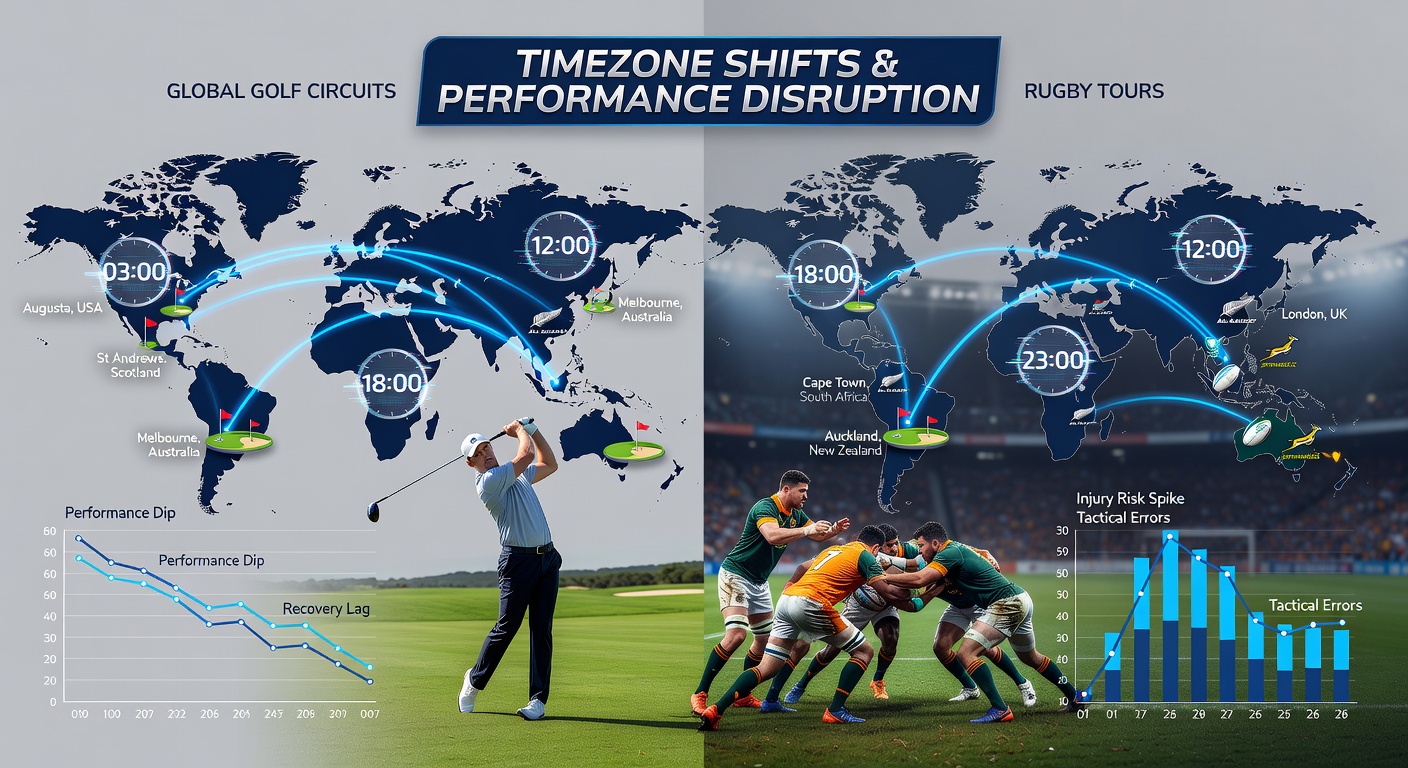
Golf circuits such as the PGA Tour and DP World Tour involve repeated flights between events in Asia, Europe, and North America, whereas rugby tours organized by World Rugby often feature back-to-back test matches across hemispheres. Observers note that these patterns create cumulative sleep debt because recovery windows shrink when teams or individuals move eastward or westward rapidly. Data from performance monitoring programs shows elevated error rates in putting accuracy and scrum stability during the initial 48 to 72 hours after arrival in a new zone.
Coaches have implemented light exposure protocols and scheduled training sessions timed to the destination clock, yet results vary depending on individual chronotypes and the direction of travel. Westward journeys tend to produce milder effects than eastward ones because the body adapts more readily to longer days than to shortened ones.
Performance Patterns in Golf Events
Professional golfers experience measurable declines in driving distance and approach shot precision when competing within three days of crossing six or more time zones. Tournament data from events held in June 2026 will likely highlight similar trends, as several signature tournaments cluster in different regions within a compressed calendar window. Analysts have recorded higher three-putt frequencies and missed fairways among players whose itineraries included overnight flights followed immediately by practice rounds.
Medical staff attached to tour groups monitor core body temperature shifts and melatonin levels to predict vulnerability windows, then adjust meal timing and practice intensity accordingly. These interventions produce partial mitigation but do not eliminate the underlying physiological lag that affects fine motor control and mental focus during early rounds.
Rugby Tour Adaptations and Recorded Outcomes
Rugby unions have documented comparable disruptions during Lions tours and national team expeditions, where forward packs show reduced scrum engagement power and backlines display slower defensive line speed in the opening matches. Match statistics compiled by tournament organizers reveal elevated penalty counts linked to timing errors in breakdown contests and lineout throws during the first half of series openers. Teams that allocate extra acclimatization days before the first test match demonstrate improved tackle completion percentages and fewer handling errors in subsequent fixtures.
Nutritionists coordinate carbohydrate intake and hydration schedules with the new time zone to stabilize energy availability, while strength coaches modify gym sessions to avoid peak fatigue periods. These adjustments appear in pre-tour planning documents released by several national federations ahead of the 2026 schedule.
Monitoring Technologies and Future Scheduling
Wearable devices now supply real-time heart rate variability and sleep quality metrics that medical teams review daily, allowing targeted interventions such as strategic napping or adjusted caffeine timing. League administrators have begun consulting these datasets when constructing calendars, although commercial broadcasting commitments continue to dictate many fixture placements. Research published through the Sleep Research Society underscores that consistent access to such monitoring reduces but does not erase performance variance tied to timezone transitions.
Event organizers have explored holding more regional clusters of matches to limit long-haul segments, yet revenue considerations tied to global audiences maintain pressure for geographically dispersed schedules. Both golf and rugby governing bodies track injury incidence alongside performance metrics to assess whether cumulative travel load correlates with elevated soft-tissue issues in later tour stages.
Conclusion
Timezone shifts continue to register as a quantifiable influence on execution quality in golf circuits and rugby tours, with data sets confirming temporary reductions in accuracy, power output, and decision speed. Governing bodies and support staff apply established recovery protocols and emerging technologies to manage these effects, while calendar planners weigh commercial demands against athlete welfare indicators. Ongoing collection of biometric information from wearable systems will likely shape future adjustments to tour structures across both sports.